- Indoor
- Toddlers
Montessori play ideas at home: simple everyday activities for children
Note: This article contains affiliate links. If you buy something through a link, we may receive a small commission. There is no extra cost to you.
Looking for new places to visit and exciting events? Download the Unitee app and discover more!
Children do not always need expensive toys or a perfectly set-up bedroom to be meaningfully occupied. Often simple everyday materials, a calm setting and tasks where children get to be active themselves are enough. This is exactly where Montessori-inspired play ideas come in.
The Montessori approach is based on the idea that children learn through trying things out, repeating them and acting independently. At home this does not mean everything has to be set up strictly according to Montessori principles. What matters far more is the idea behind it: children get to discover things themselves, touch them, sort them, pour them, feel them, build with them and try them out.
In this article you will find simple Montessori-inspired play ideas for at home that need little preparation and fit well into everyday family life.
What does Montessori-inspired play mean?
Montessori-inspired play means that children can become active as independently as possible. They are given materials that are laid out clearly, are easy to handle, and are suited to their age. Rather than lots of overstimulation, it is more about calm, clear activities.
Typical are activities in which children:
sort things
feel and compare materials
pour or spoon water
recognise colours and shapes
imitate everyday tasks
train their fine motor skills
decide for themselves what to occupy themselves with
The focus is not on a perfect result. It is about children practising with concentration, finding their own solutions and experiencing a sense of achievement.
1. Sorting game with everyday objects
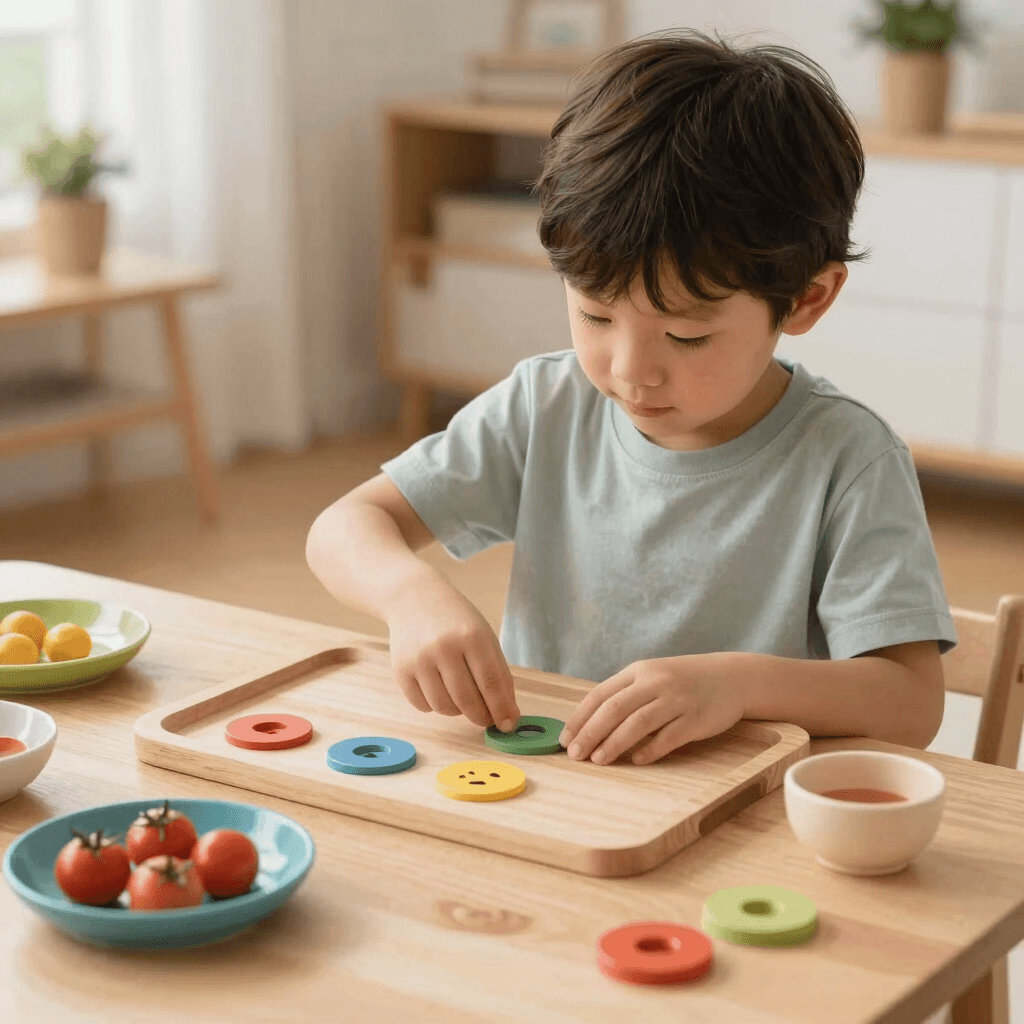
A very simple Montessori-inspired activity is sorting. You do not need any special materials for this. You could use, for example, buttons, building blocks, large pasta shapes, lids, shells or wooden figures.
Children can sort the objects by colour, shape, size or material. Two categories are enough for younger children, for example "red" and "blue". Older children can form more complex groups.
Good options are:
sorting boxes, small baskets, wooden trays, coloured bowls or large wooden beads.
This activity supports concentration, fine motor skills, logical thinking and the ability to notice differences.
2. Pouring and transferring water
Many children love water. A simple pouring station can keep them occupied for a long time while supporting hand–eye coordination.
All you need is a small jug, two cups, a tray and some water. The child can pour water from one container into another. Small amounts are best to start with, so it does not spill everywhere straight away.
Later, you can extend the activity, for example with a funnel, sponge or small spoons.
Suitable materials would be:
small kids' jug, measuring cup, funnel set, non-slip tray or a child-sized apron.
Important: this activity is best done in the kitchen, the bathroom, or outdoors.
3. Spooning with rice, beans or lentils
A classic calm activity is transferring things with a spoon. You can use dry rice, lentils, beans or large pasta shapes for this.
Put two small bowls on a tray. One bowl holds the material, and it gets transferred to the other bowl with a spoon. A large spoon is enough for younger children. Older children can practise with smaller spoons or tongs.
Suitable for this are:
small wooden bowls, kids' spoon, sorting tongs, trays or sensory play materials.
This activity trains fine motor skills, patience and concentration. Many children also find it calming.
4. A feely box with natural materials
A feely box is a lovely way to discover different materials with your hands. You can use things you collect outdoors: leaves, pine cones, stones, conkers, shells or small pieces of wood.
Put the materials in a box or basket. The child can feel, compare, describe and sort them. Are the stones cold or warm? Is the leaf smooth or rough? Is the pine cone heavy or light?
A explorer set with binoculars and a magnifying glass (affiliate link) adds their own observations to the natural materials.
Suitable would be:
natural materials box, collecting basket, wooden tray, feely bag or magnifying glass for kids.
This play idea combines sensory experience with language, nature observation and independent discovery.
5. Matching colours
For a simple colour game, you can use coloured paper circles, building blocks, clothes pegs or small play objects. The child matches objects to the correct colour.
You could, for example, lay coloured sheets of paper on the floor and the child looks for matching things in the room. A red building block goes on the red sheet, a yellow lid on the yellow sheet.
Suitable materials:
colour cards, rainbow wooden toy, coloured sorting bowls, building blocks or wooden clothes pegs.
This activity helps children notice colours consciously and categorise things.
6. Acting out everyday life: laying the table
Montessori-inspired activities do not always have to look like "play". Many children love real everyday tasks. Laying the table is a good example.
You can prepare a small area for your child: plate, cup, napkin and cutlery. The child practises putting everything in the right place. For younger children, you can draw a template showing where the plate, glass and cutlery go.
Suitable would be:
child-friendly tableware, small cutlery set, placemat with cutlery markings or sturdy kids' cups.
Tasks like these support independence and give children the feeling that they can really contribute.
7. What belongs together?
This activity is about finding pairs or things that belong together. For example:
a sock and its matching sock
a key and a lock
a toothbrush and toothpaste
a spoon and a bowl
an animal figure and its matching picture
You can use simple everyday objects or prepare picture cards. The child matches up what belongs together.
An age-appropriate learning and early-reading game (affiliate link) offers further picture-matching tasks.
Suitable materials:
picture cards, a memory game, animal figures, matching games or wooden everyday objects.
This idea supports logical thinking, language and powers of observation.
8. Screwing, opening and closing
Many children are fascinated by things that open, close, twist or click shut. You can prepare a small station with various tins, lids, screw-top jars and small boxes.
The child tries out which lid fits which container. They can open, close, twist and compare the containers.
This busy board (affiliate link) offers various fasteners and tasks for little hands.
Suitable materials:
screw-top jars, wooden boxes with fasteners, activity board, lock-and-latch toy or busy board.
This activity is especially good for fine motor skills, problem-solving and patience.
9. A little cleaning station
Children often want to do what adults do. A little cleaning station can therefore be surprisingly popular. You could set out a small cloth, a spray bottle of water and a sponge.
The child gets to wipe a table, clean toys or polish a mirror. What matters is that the task is real and the child genuinely gets to do something.
Suitable materials:
kids' broom, small dustpan set, microfibre cloths, spray bottle for kids or child-friendly cleaning set.
Activities like these strengthen independence and a sense of responsibility.
10. Laying out shapes with sticks or stones
With wooden sticks, lolly sticks, stones or building blocks, children can lay out simple shapes: circles, triangles, squares or lines. Older children can also copy patterns or letters.
You can create a shape first and let your child try to copy it. Or the child can freely lay out their own pictures and patterns.
Suitable materials:
wooden sticks, shape-laying tiles, magnetic building blocks, wooden blocks or pattern cards.
This activity supports spatial thinking, creativity and fine motor skills.
Tips for Montessori-inspired play at home
You do not need to offer many things at once. Less is often better. A small tray with one clear activity is completely enough.
It helps to:
lay out materials clearly
offer only a few things at a time
give the child time to repeat things
not step in too quickly
allow genuine everyday tasks
swap toys around regularly
adapt activities to the child's age
One important idea: the child does not need to be "kept busy". They get to become active themselves. This is exactly what often leads to longer, calmer periods of play.
What age are Montessori-inspired play ideas suited to?
Many ideas can already be done very simply from around 1.5 to 2 years old, for example sorting, spooning or pouring water. For older children, the tasks can become more complex, for instance with patterns, numbers, letters or small everyday tasks.
It always matters that the materials are safe. Small items such as beans, beads or buttons are only suitable for children who no longer put things in their mouth, and should always be supervised.
Conclusion: Montessori-inspired play does not have to be complicated
Montessori-inspired play ideas for at home do not have to be expensive or perfectly prepared. Simple everyday objects, a bit of calm and the chance for children to try things out themselves are often all it takes.
Sorting, pouring, feeling, laying out, opening, closing and taking on little household tasks – all of this can be valuable for children. Along the way they build concentration, fine motor skills, independence and confidence in their own abilities.
And if, alongside calm play ideas for at home, you are also looking for suitable activities, classes and family events beyond your own four walls, Unitee can help you discover offers near you more easily.
Discover even more with Unitee
Looking for new places to visit and exciting events? Download the Unitee app and discover more!