- Outdoor
Montessori play ideas outdoors: simple activities in nature
Looking for new places to visit and exciting events? Download the Unitee app and discover more!
Outdoors, children often need very little to start playing, discovering and learning. A few stones, leaves, sticks, some water or sand are often enough for them to experiment, sort, build and observe with real focus. This is exactly where Montessori-inspired play ideas fit so well.
The Montessori approach assumes that children learn through their own actions. They want to touch things, try them out, repeat them and find out for themselves how something works. Outdoors, nature offers a particularly lovely, ready-made environment for this: it is full of shapes, colours, textures, sounds and opportunities to move.
In this article you will find simple Montessori-inspired play ideas for outdoors that work well in the garden, park, woods, playground or on a walk.
What does Montessori-inspired outdoor play mean?
Montessori-inspired play outdoors does not mean you need to prepare a special learning programme. It is far more important to give children the space to discover things for themselves.
Outdoors, children can:
collect and sort natural materials
observe animals and plants
balance, climb and run
experiment with water, sand and soil
take on small everyday tasks
discover colours, shapes and patterns
consciously use their senses
It is not about getting something "right" at the end. The process is far more valuable: the child observes, tries things out, repeats, and develops their own ideas.
1. Collecting and sorting natural materials
One of the simplest Montessori-inspired outdoor activities is collecting and sorting. Children can collect leaves, stones, sticks, pine cones, shells or conkers and then arrange them.
You could sort by, for example:
colour
size
shape
weight
surface
material
A small basket or fabric bag is all you need. At home or right there outdoors, the finds can be laid out on a cloth.
This activity supports concentration, perception, fine motor skills and early logical thinking.
2. Looking for colours in nature
In this play idea, the child looks for particular colours outdoors. You could say, for example: "Can you find something green?" or "What is yellow here?"
It is even nicer with colour cards. The child gets a colour card and looks for matching things in the surroundings: a green leaf, brown bark, a yellow flower or a grey stone.
This activity helps children notice colours consciously and observe their surroundings more closely.
3. A barefoot path in the garden or park
A barefoot path is a wonderful sensory activity. Different materials can be laid out on the ground for it, for example grass, sand, pebbles, leaves, soil or pieces of wood.
The child walks slowly across it and feels the differences. Is something soft, cold, rough, prickly or smooth?
This activity strengthens body awareness, balance and sensory development. At the same time, it is often great fun for children.
4. Pouring water in the garden or on the balcony
Many children love working with water. A small watering can outdoors can already be a whole activity in itself. Children can water plants, pour water from one container into another, or do small water experiments.
You can show the child which plants need water, and then let them try it themselves. That turns a simple task into a meaningful everyday experience.
This activity supports independence, coordination and a sense of responsibility.
5. Small-scale gardening for children
Gardening fits the Montessori idea very well, because children get to take on real tasks. They can dig over soil, plant seeds, collect leaves or pull weeds.
Even without a garden of your own, this works on a balcony with small pots or a planter box.
Children experience that their work has a real purpose. They see how plants grow and develop a sense for nature and responsibility.
6. Washing stones
Washing stones sounds simple, but it keeps many children busy for a surprisingly long time. All you need is a small bowl of water, a brush or sponge, and a few collected stones.
The child can clean the stones, compare them and then sort them. Which stones are smooth? Which are heavy? Which change colour when they get wet?
This play idea supports fine motor skills, concentration and sensory perception.
7. Feeling leaves and bark
There are many different surfaces outdoors. Children can feel and describe leaves, tree bark, grass, stones, sand or moss.
You can ask questions like:
What feels soft?
What is rough?
What is cold?
What is dry?
What is smooth?
This activity supports language, perception and conscious observation.
8. Making a nature mandala
A nature mandala is a calm, creative activity. Children collect leaves, blossoms, stones, sticks or cones and arrange them into a pattern on the ground.
This can be a circle, a spiral, a sun, or a completely free pattern. This activity is especially lovely in the park, woods or garden.
Nature mandalas support creativity, concentration and a feel for pattern and symmetry.
9. Balancing on logs or lines
Movement matters a lot outdoors. A simple Montessori-inspired movement idea is balancing. The child can balance on a log, a line on the ground, a kerb edge or a rope.
You can add small variations:
walking slowly
walking backwards
balancing with arms outstretched
carrying an object
stepping over small obstacles
This activity supports balance, body control and self-confidence.
10. Nature bingo on a walk
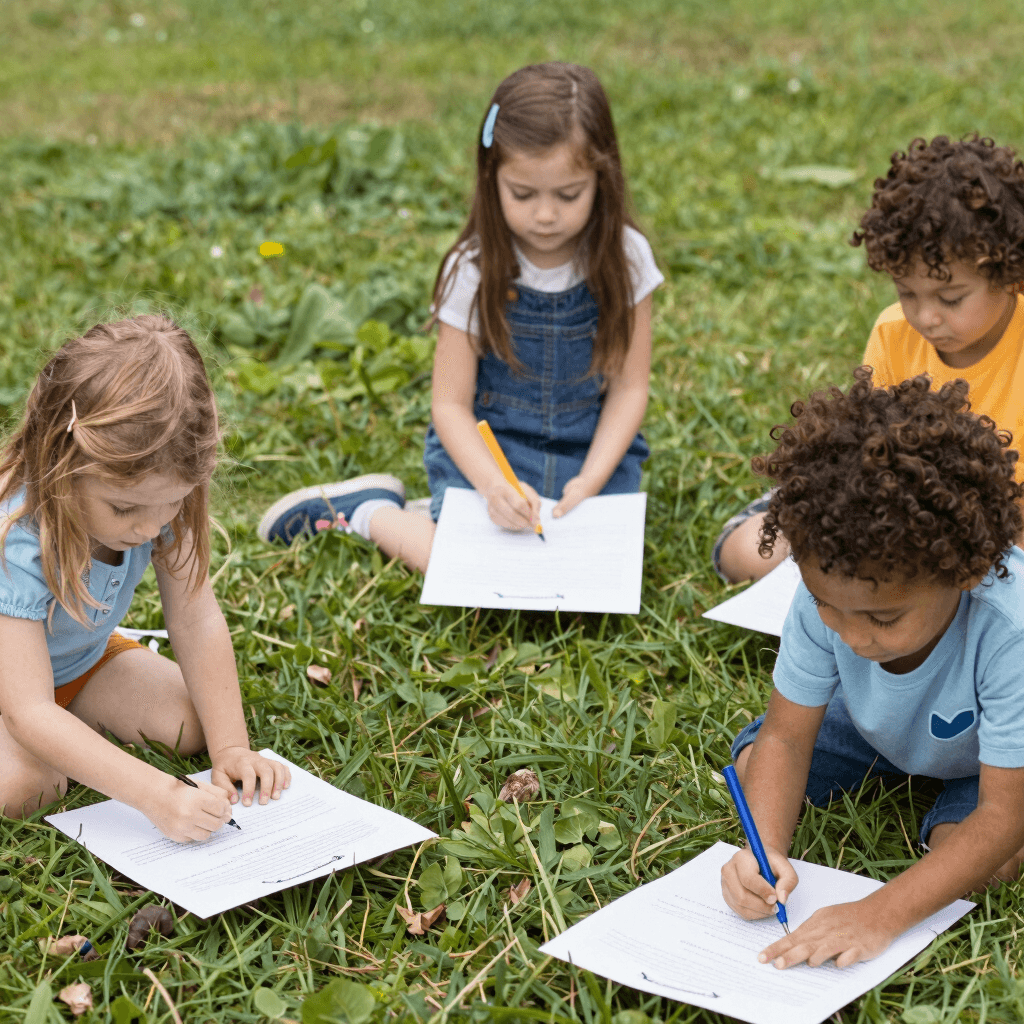
Nature bingo makes a walk more exciting without making it complicated. You can prepare a small list of things for the child to look for.
For example:
a round leaf
a small stone
something yellow
a bird
a stick
a flower
something soft
something rough
This activity helps children move through their surroundings more attentively and notice details.
11. Listening for sounds
There are many sounds outdoors that children can consciously notice. Sit down together for a moment on a bench, a blanket or in the grass and listen.
What can you hear?
birds
wind
cars
footsteps
leaves
dogs
voices
water
This activity supports mindfulness, concentration and verbal expression.
12. Watching small creatures
Children are often fascinated by ants, beetles, birds, snails or butterflies. A Montessori-inspired way of watching animals means: observing without disturbing.
The child can look at:
How does the animal move?
Where is it going?
What colour is it?
Is it fast or slow?
Where does it live?
This activity builds patience, respect for animals and an early understanding of nature.
13. Sieving and pouring sand
In a sandpit or on the beach, children can pour, sieve, dig and shape sand. This fits the Montessori principle wonderfully, because children can repeat, experiment and work independently.
They can fill sand from one cup into another, filter out small stones with a sieve, or compare different quantities.
This activity trains fine motor skills, coordination and an early understanding of quantity.
14. Watching shadows
On sunny days, children can discover shadows. They can observe what their own shadow looks like, how long it is, and how it changes as they move.
You can also place small objects on the ground and look at their shadows. Older children can trace the shadow with chalk.
This activity combines movement, observation and an early understanding of light.
15. Small picnic preparations
A picnic can be Montessori-inspired too, if children are allowed to take on real tasks. They can spread out a blanket, hand out cups, wash fruit or put small snacks into containers.
It is not just about eating, but about independence and everyday competence.
Children experience: I can help. I can prepare something. I am part of the shared activity.
Tips for Montessori-inspired outdoor activities
Montessori-inspired outdoor play works best when children have enough time. It does not always have to be a big destination. A short walk, the back garden, a park or the balcony can be enough.
It helps to:
use simple materials
give the child time to observe
not offer too many tasks at once
allow genuine nature experiences
keep weatherproof clothing ready
bring small baskets or bags for collecting
adapt activities to the child's age
It also matters that children are allowed to repeat things. If your child wants to pour water back and forth ten times, that is not boring – it is learning through repetition.
What age are Montessori-inspired outdoor play ideas suited to?
Many ideas already work well for toddlers from around 1.5 to 2 years old, for example pouring water, collecting stones, feeling leaves or pouring sand.
For older children, the activities can become more demanding. They can play nature bingo, observe plants, arrange small patterns, trace shadows or keep their own nature diary.
With small items like stones, conkers or beans, always make sure they are not put in the mouth. Outdoors it also holds true that children should be supervised while playing with water, natural materials and small creatures.
Conclusion: outdoors, children learn with all their senses
Montessori-inspired outdoor play ideas do not have to be elaborate. Nature already offers children a rich learning environment. They can feel, hear, see, smell, sort, build, pour, balance and observe.
Especially simple activities like washing stones, collecting leaves, pouring water or watching animals can help children become more focused, more independent and more mindful.
And if, alongside nature play ideas, you would also like to discover matching family activities, classes, children's events or days out near you, Unitee can help you find suitable offers for your family life more quickly.
This article contains affiliate links. If you buy something through a link, we may receive a small commission. There is no extra cost to you.
Discover even more with Unitee
Looking for new places to visit and exciting events? Download the Unitee app and discover more!